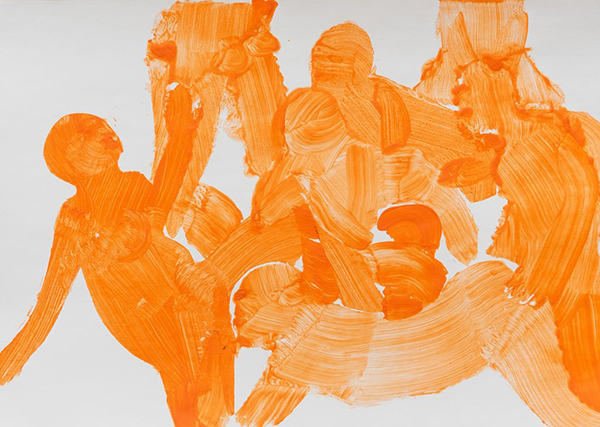
April 10th, The Washington Post, USA
from the series ‘March to May’, 2020
inkjet print and pencil on paper
42.1 x 29.5 cm
Tatiana Trouvé. From March to May
18 September – 30 October 2021
Gagosian Gallery, New York
Links: [Tatiana Trouvé] [Gagosian Gallery] [Gagosian Quarterly]
Tatiana Trouvé
April 14th, La Tercera, Chile
from the series ‘March to May’, 2020
inkjet print and pencil on paper
42.1 x 29.5 cm
[from the pressrelease]
“When the quarantine was announced, newspapers from countries around the world being ravaged by the pandemic took on new meaning. I began, each day, to draw on the front page of a paper—it was a way of escaping the confinement, and of being connected to the strange atmosphere that was spreading around the globe with the virus. This world tour via headlines and front pages was like a journey in reverse. Suddenly, I could no longer meet the world unless the world came to me, through the newspapers. Governments and leaders around the world should have seen this as an opportunity to reconsider our societal and economic models. But no. This crisis has only heightened my anger at the inequalities we accept daily, and at the contempt we show for our planet.
—Tatiana Trouvé
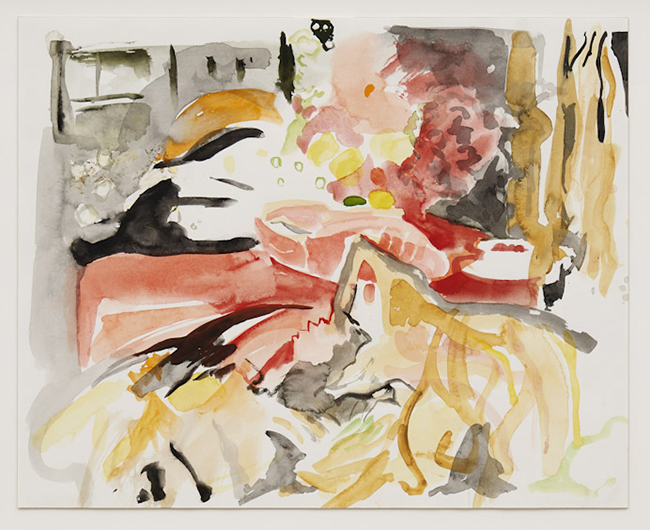
The Spoils, 2020
Gouache and watercolor on paper
40.6 x 50.8 cm
Cecily Brown. Pronkstilleven
17 September – 30 October 2021
Gladstone Gallery, Brussels

Pronkstilleven, 2020-2021
Pastel on paper
80 x 120.7 cm
[from the pressrelease]
Taking inspiration from pronkstilleven, a 17th-century Flemish style of still-life painting, Brown presents a series of drawings, pastels, and watercolors that celebrate a local art historical tradition through her singular and multifaceted approach to artmaking.
Typically comprised of fruits, vegetables, game, flowers, and other household objects, pronkstilleven paintings were meant to signify the wealth and excessive abundance of the aristocratic class during the 1600s. Frans Snyders, an early and influential figure from this artistic movement, excelled at creating these hyperrealist, ornate settings. Similar to Brown’s larger-scale paintings, the pastels in this show take motifs from existing imagery, primarily the still life paintings of Snyders, which she transforms into entirely new works that admiringly riff off of the preceding visual material. Drawing is an integral yet lesser known component of her work, which has recently been the subject of public and museum exhibitions. Unlike the 19th-century practice of creating esquisses, or preparatory drawings and oil sketches for larger paintings, Brown’s drawings on paper are finished works unto themselves, and provide striking insights into her intuitive artmaking process. The artist notes that in order to learn an image, she takes photographs and images of paintings and copies them, however, while employing the visual language she has developed throughout her career.
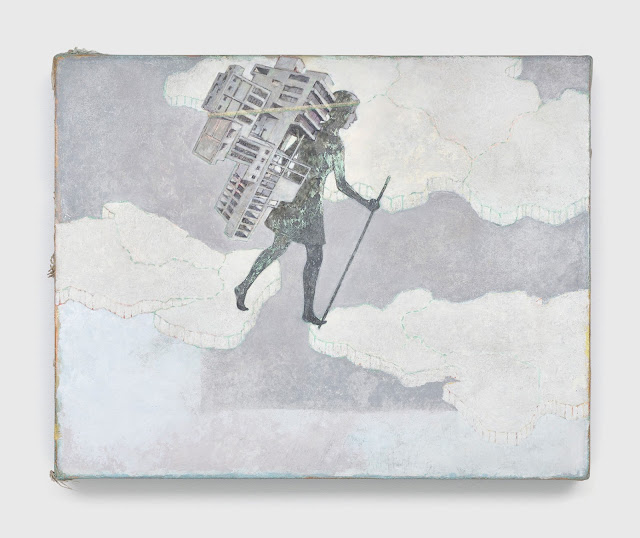
Untitled (study for Le Juif Errant Gibraltar), 2008
Oil, collage and pencil on canvas
32.5 x 40.5 cm

Francis Alÿs
Untitled (Study for ‘Don’t Cross the Bridge Before You Get to the River’), 2006-2008
Oil, encaustic, and graphite on canvas on panel
19.4 x 24.4 cm
[from the pressrelease]
Don’t Cross the Bridge Before You Get to the River brings together a group of works made by the artist from 2006 onward that relate to an action that took place simultaneously on opposite shores of the Strait of Gibraltar—in Tangier, Morocco, and Tarifa, Spain—on 12 August 2008. This is the first solo presentation in Paris for the internationally acclaimed artist, who will represent Belgium at the 2022 Venice Biennale.
Alÿs is known for his in-depth projects in a wide range of media, including documentary film, painting, photography, performance, and video. Through his practice, Alÿs consistently directs his distinct poetic and imaginative sensibility toward anthropological and geopolitical concerns centered around observations of, and engagements with, everyday life. The artist himself has described his work as “a sort of discursive argument composed of episodes, metaphors, or parables.”
Since 2004, the artist has shifted his attention to the inherent sociopolitical conflict in border regions, making works in interstitial locales such as the Strait of Gibraltar, Jerusalem, the Turkish-Armenian border, the open water between Havana and Key West, Florida, and the Panama Canal Zone. Don’t Cross the Bridge Before You Get to the River is a prime example of Alÿs’s tenet that the poetic and the political are intimately connected. Here, Alÿs again examines geographical and philosophical notions of borders as well as larger issues concerning freedom of movement. Alÿs prepared for this action, which is documented in a two-channel video, over the course of many years.
All videos included in this exhibition were created in collaboration with Julien Devaux, Ivan Boccara, Rafael Ortega and Felix Blume. On the appointed day, a line of local children, each holding a small boat fashioned from a shoe, assembled on the beach in Tarifa and a counterpart line of children holding shoe-boats gathered on the beach in Tangier. Attempting to bridge not only continents but also cultures, the two lines of giggling children waded into the lapping waves, trying to move toward each other, while the tide relentlessly pulls them back to the shore, in an effort to answer the question posed by Alÿs: “Will the two lines meet in the chimera of the horizon?”
In addition to the video documentation, Alÿs created an important group of paintings, drawings, and sculptures. Made on site as well as in the studio, they allow the artist to experiment with similar ideas and themes in a more solitary and introspective way. The paintings allow the artist to stay connected to the project throughout the different stages of the process, often over the course of several years. Alÿs also uses image as his main communication system in order to express and explain his intentions to his collaborators. Throughout his practice, Alÿs has utilized a combination of abstract and realist motifs in his paintings in order to address the inherent difficulty of representing complex concepts directly.

Daily Geometry #5, 2021
pastel pencils on paper, plexiglass, wooden frame
20 ⅛ × 14 ¾ × 1 ⅝ inches
David Maljković
Daily Geometry
8 – 26 June, 2021
T293 Rome

Daily Geometry #2, 2021
pencil on paper, plexiglass, wooden frame
20 ⅛ × 14 ¾ × 1 ⅝ inches
Categories
Index